
Dog Racing Gets on Track in El Cerrito
By Jon Bashor
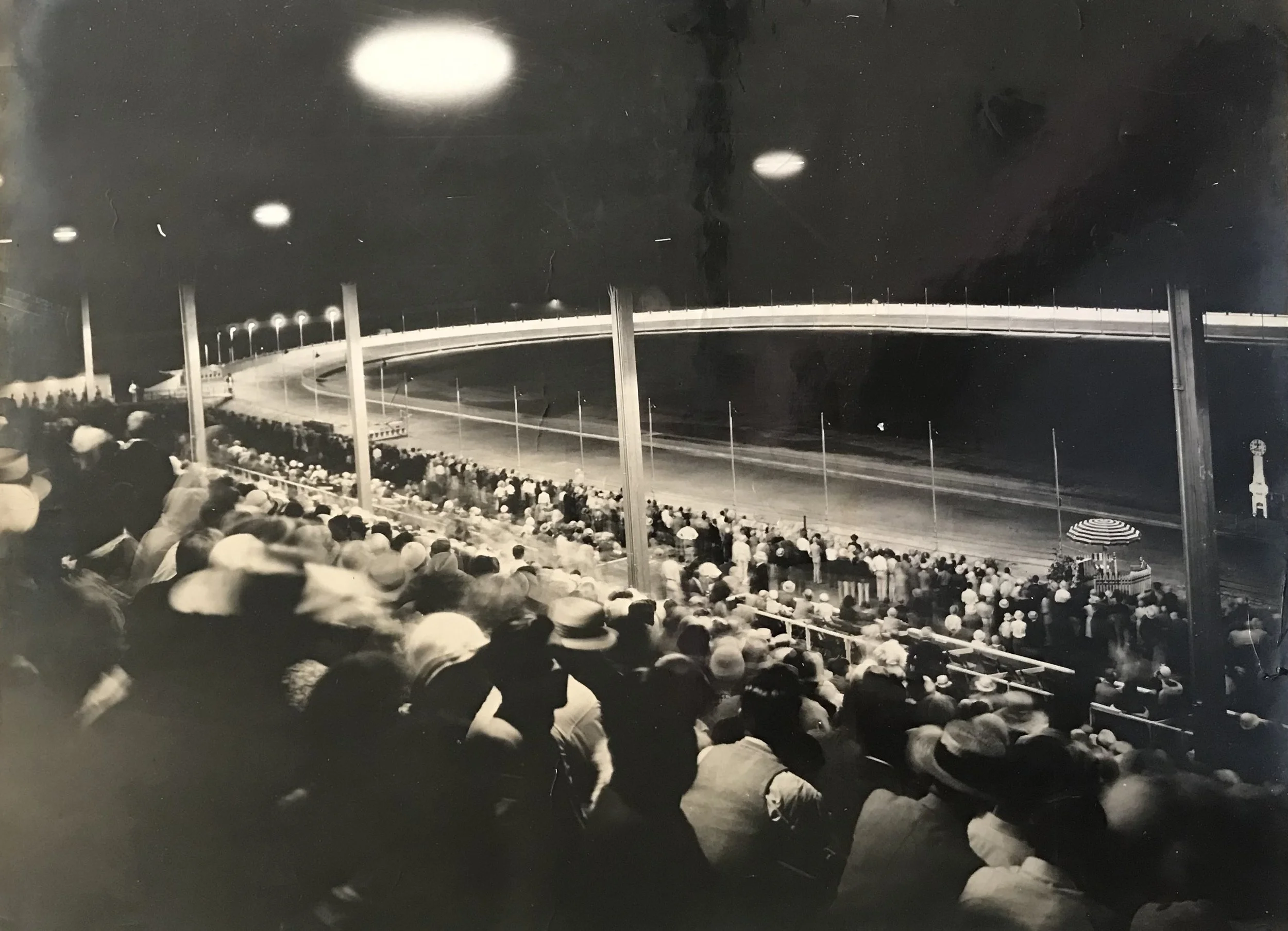
Race fans fill the stands at the El Cerrito Kennel Club track in this undated photo from the EC Historical Society collection.
At 8:15 p.m. on Saturday, Oct. 22, 1932, a new era in nighttime entertainment opened as Sue Fulton, Hughminnia, Prairie Foe, Berta, Ford 8, Bona Fide, Over & Over and Lady Gog chased a speeding mechanical rabbit for 3/16 of a mile (330 yards) around a new track built specifically for greyhound racing.
“The El Cerrito Kennel Club, of El Cerrito, Calif., presents to greyhound racing followers what experts declare to be the finest and most modern plant in the United States, both in point of comfort and equipment,” read the introductory paragraph in the opening night program. “The track manager will be Mr. George F. Chapman of San Francisco who has held similar positions at prominent tracks in the country. His integrity is of the highest among followers of the sport.”
In his 1977 book “El Cerrito: Historical Evolution,” Edward Staniford wrote “The racetrack was a stellar attraction of the Bay Area drawing clientele from as far away as Los Angeles and Reno.”
The track, with a grandstand that could easily hold 3,000 fans, put El Cerrito in the same league as Emeryville (the first in the state), San Pablo, Menlo Park, San Bruno, South San Francisco, Alviso, Union Park and Bayshore City. When the El Cerrito Kennel Club was finally forced to shut down in 1939, it was the last dog track standing in California.
For seven years, the dogs were running in eight to 10 races six days a week around the quarter-mile oval. Races ranged in distance from 330 to 500 to 550 yards. Before each race, fans could peruse details about each of the competitors based on their past performances.
“Greyhounds racing under the rules of the El Cerrito Greyhound Breeders’ Association are carefully classified and graded, and their record printed in the program for the prospective purchaser or option holder to buy,” according to a guide printed in the programs. “Anyone studying this information may easily judge the probable performances of the different greyhounds.”
But at the time, betting on races was illegal, so the dog and horse racing track operators created a loophole a full-grown greyhound could run through. The key word was option. Rather than placing bets, racing fans could purchase options on their favorite dog. If their pick did well, the fans could redeem their option for the stated purchase price published in the evening program. If not, they lost their investment.
“Any person in good standing upon the turf may buy an option to claim, pursuant to the claiming rules of the El Cerrito Greyhound Breeders’ Association, any dog at the price for which it is entered, which price is printed upon the program,” the program noted.
On the track
The track was located south of Fairmount Avenue between San Pablo Avenue and the Santa Fe Railroad right-of-way (where today’s BART tracks are located), placing it on the current site of the El Cerrito Plaza shopping center. Some street maps of the era included the “Dog Race Track” location. When construction started, the land was used as pasture adjacent to the rundown Castro Adobe.
Prior to each race, a grand marshal marched along the track to the starting gate. Behind him came the hounds, each accompanied by a uniformed groom. The racers were led into a “stall starting box, the most popular of all systems…instead of the strap method which causes much confusion at many tracks,” according to the opening night program. The track boasted that it used the Heintz Starting Box, which offered a number of advantages to both the track operators and the greyhounds (see image).
The rabbit chased by the dogs sped around the track at about 35 mph. According to the program, “The inside rabbit will also be used, preferable to most of the owners.”
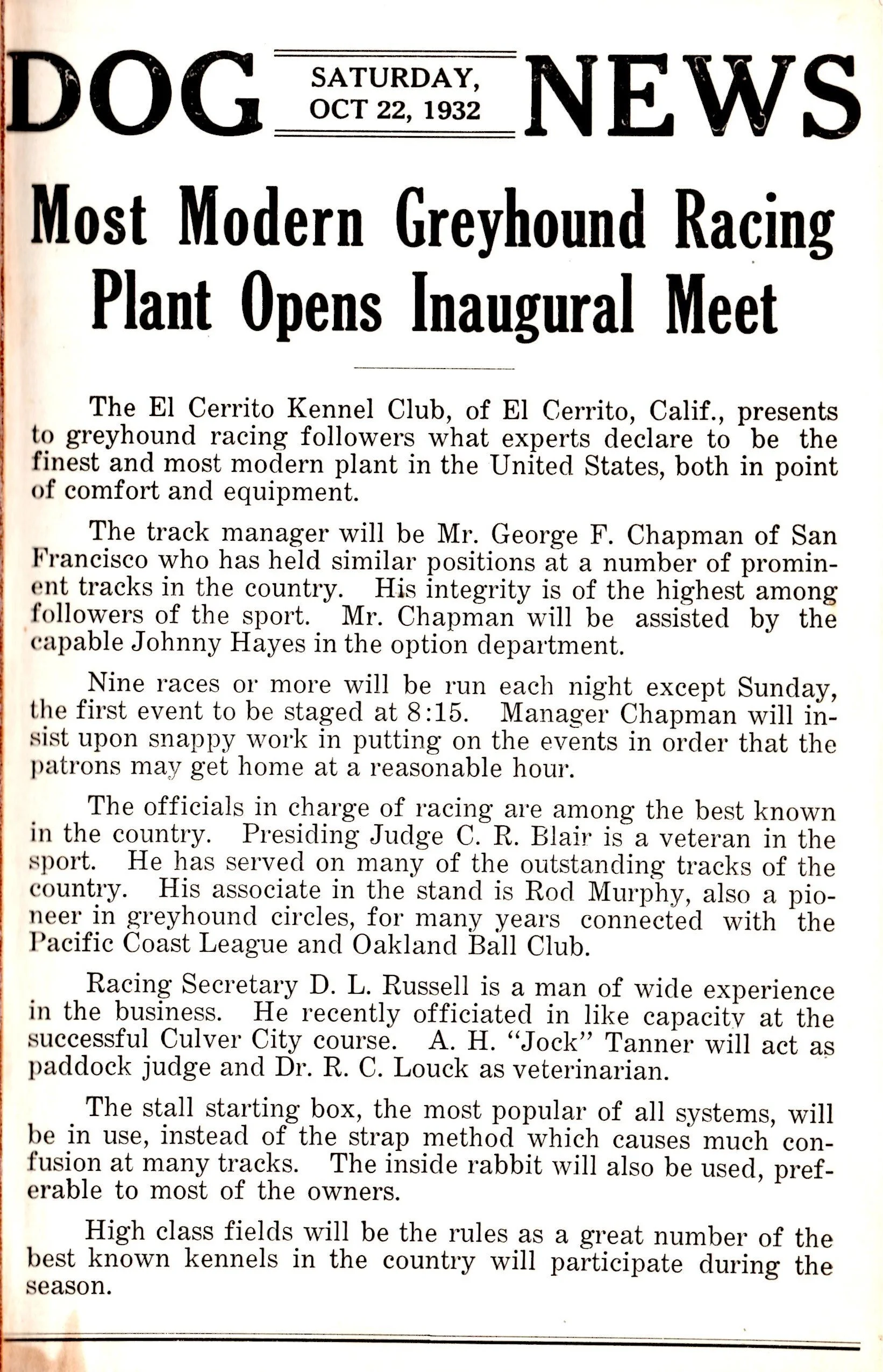
The opening page of the program from opening night of the El Cerrito Kennel Club in 1932. EC Historical Society collection.